
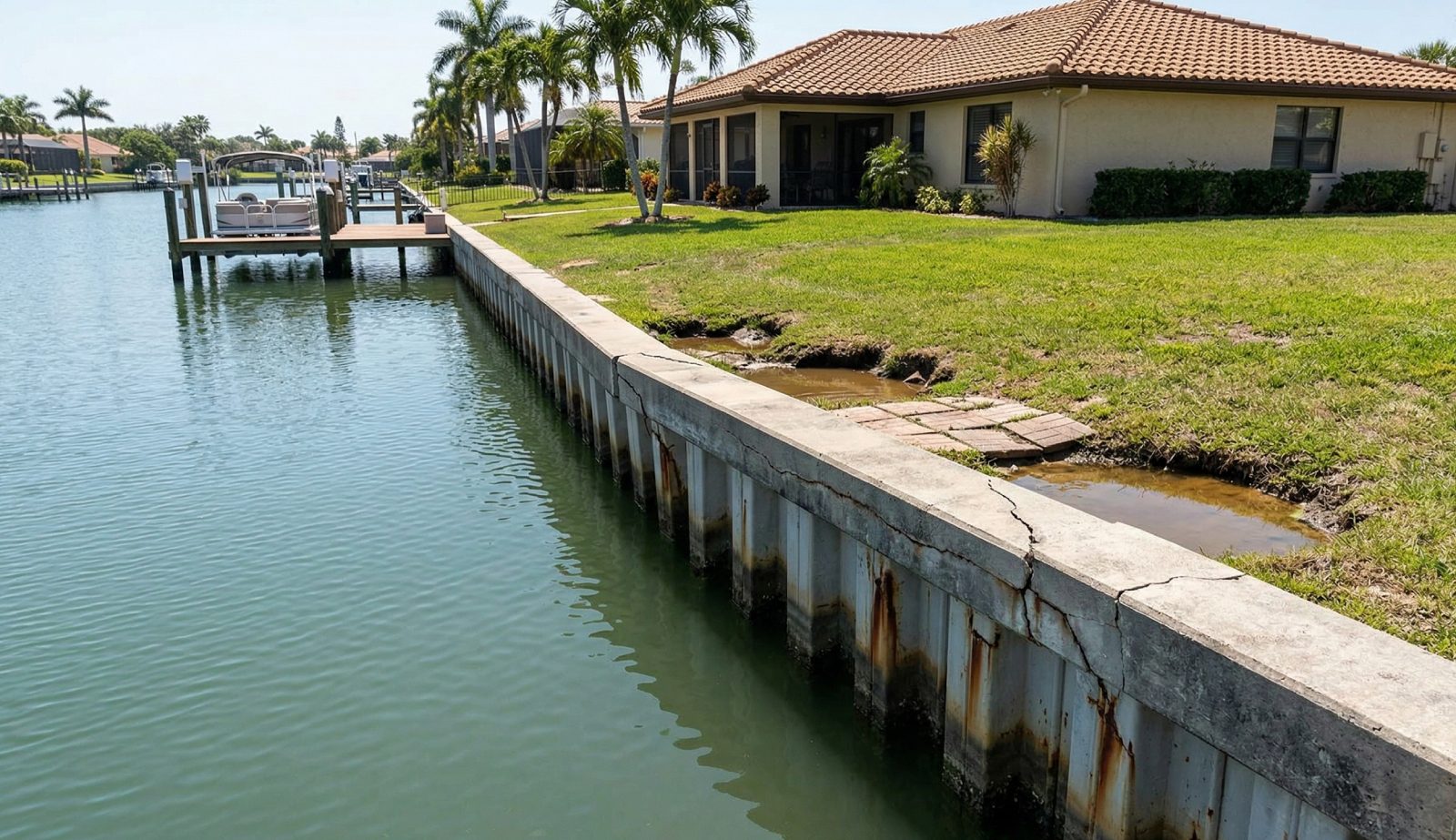
If you own waterfront property, a seawall is probably one of the most important structures on it. It is also one of the least understood. Most owners think of a seawall as a barrier that holds back water. That is only half the story.
A seawall does two jobs at the same time, every day. It keeps water out of your property, and it keeps the land in. The second job is the one that determines whether the structures on your property stay stable, whether your yard stays where it should, and whether your home retains its value over time.
The dual purpose, in plain terms
On one side of a seawall is the water. That might be the ocean, a lake, a river, a canal, or an inlet. On the other side is soil. That soil is what your house, patio, pool deck, dock approach, and landscaping all sit on. Without a barrier between the two, tidal action, storm surge, boat wakes, and steady wave energy would pull that soil away over time. Waterfront living as most owners know it would not be possible.
A seawall holds the line. It also has to manage water pressure on both sides, letting drainage from the land escape without letting soil escape with it. That is a more delicate balance than it sounds, and it is why a well-designed seawall is an engineered structure rather than just a wall.
Why waterfront communities rely on them so heavily
A significant amount of desirable waterfront real estate exists because seawalls made it buildable in the first place. Without them, shorelines would constantly retreat, and any structure within fifty feet of the water would be at risk. That dependence is true whether the property sits on an ocean coast, a major lake, a tidal river, or a residential canal system.
Seawalls are more than a feature of a property. In many cases, they are the reason the property exists in its current form at all.
What this means for property owners
A seawall is infrastructure. It is not landscaping, and it is not a fence. When it is working, it is invisible. You do not notice it because it is doing its job. When it starts to fail, the symptoms often show up somewhere other than the wall itself: a depression in the yard, a soft spot near the patio, a settling deck. By the time the wall is visibly leaning or cracked, the underlying problem has usually been developing for some time.
Understanding what a seawall does is the first step in protecting one of the most important assets on a waterfront property.
How Ultramarine Solutions can help
Ultramarine Solutions works with homeowners, HOAs, condo associations, and commercial property owners to evaluate, repair, and replace seawalls and retaining walls. If you are not sure what condition your wall is in, or whether it is doing both of its jobs the way it should be, we can come out and take a look. Site evaluations are no-cost and no-pressure. You get a clear read on what is happening with your wall, and you decide what to do from there.
Contact us to schedule an evaluation.